
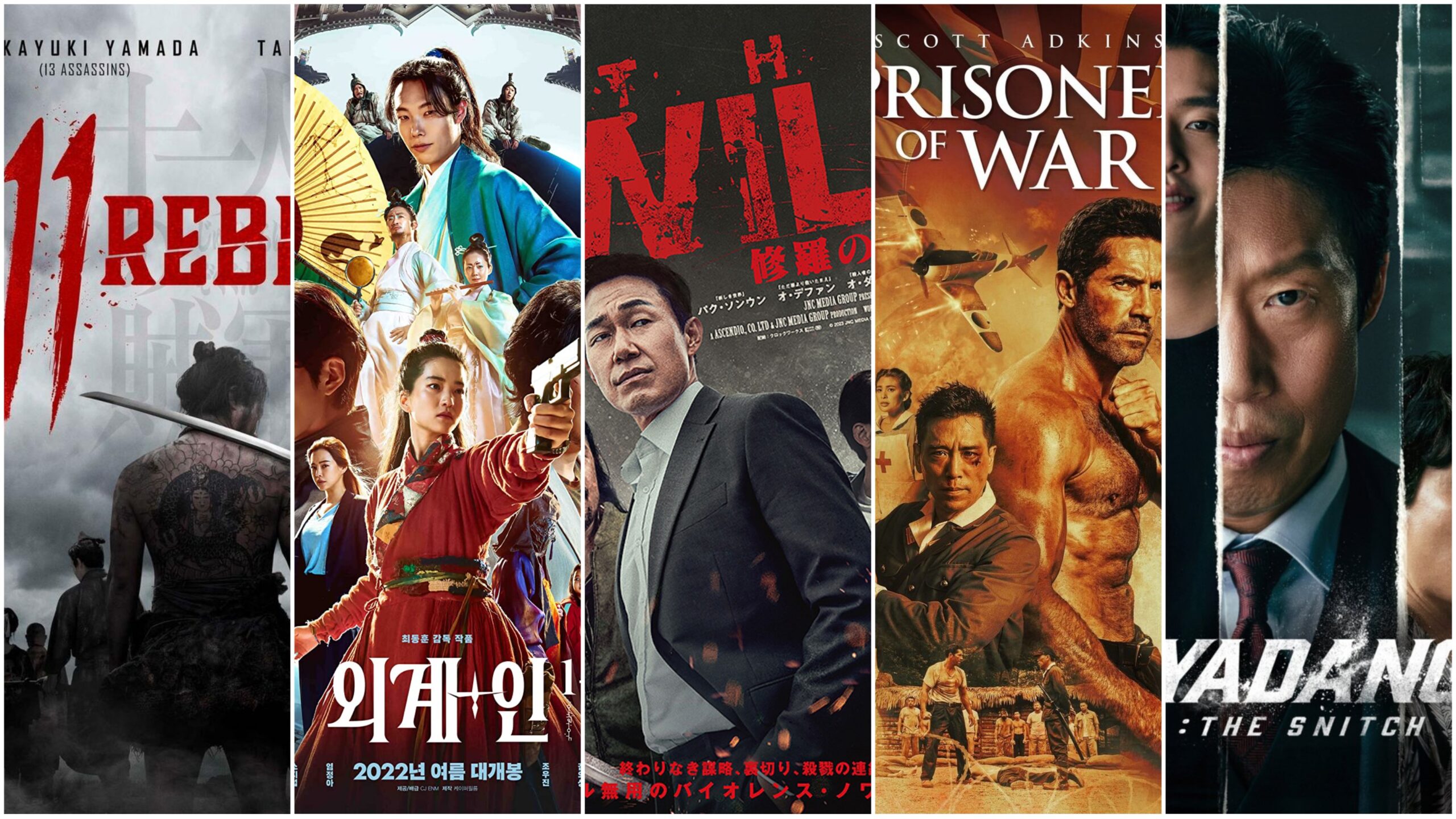
‘11 Rebels’
Two things make a great samurai movie: expert staging and an unlikely hero. Both are present in Kazuya Shiraishi’s precisely crafted “11 Rebels,” set during the Japanese civil war in 1868. Its protagonist is Masa (Takayuki Yamada), a prisoner who is enlisted to defend a remote fort from the approaching imperial army.
Because he was incarcerated for killing his wife’s rapist, a samurai, Masa struggles to fit in with the fort’s leader, Washio (Taiga Nakano). Nevertheless, the pair become a formidable duo as these prisoners-turned-soldiers push back several attacks by staging a smoke-filled battleground that allows them to slash and burn invading soldiers. Each confrontation relies on fluid swordplay and thundering explosions arising from gun and cannon fire, blending classic genre archetypes with crushing modernity for a film about revenge, brotherhood and the passing of an era.
‘Prisoner of War’
Set in 1942, the director Louis Mandylor’s brutal martial arts period piece “Prisoner of War” is the newest Scott Adkins vehicle that acutely understands his star appeal. Adkins plays James Wright, a downed British fighter pilot trapped in a Japanese prisoner-of-war camp in the Philippines where prisoners are forced by the base’s commander, Lt. Col. Benjiro Ito (Peter Shinkoda), to engage in ruthless fights to the death.
Like “Merry Christmas, Mr. Lawrence,” “Prisoner of War” considers the difficulty of defending your personhood against dehumanizing captors. It also features electric martial art sequences by Adkins. The actor’s detailed choreography contains no wasted movement; each punch and kick means something emotionally and physically as he faces off against his Japanese foes. Other events occur in “Prisoner of War,” like an elaborate escape, but it’s mostly refreshing to see an action movie wholly built around its star.
‘Alienoid 1&2’
Alienoid is a 2022 South Korean sci-fi action fantasy directed by Choi Dong-hoon. The film boldly weaves together two timelines — the Goryeo Dynasty of the 14th century and the modern world — in a story that blurs the boundaries between history and science fiction. It follows an alien race that has secretly imprisoned their kind inside human bodies on Earth. When a portal opens between the two eras, chaos unfolds as humans, aliens, and powerful Taoist sorcerers collide in an epic battle for control over a mysterious artifact known as the “Divine Blade.”
At the heart of the story is Guard (Kim Woo-bin), an alien being who monitors the imprisoned aliens, and Thunder, his AI companion. Their mission to maintain balance between the two worlds becomes complicated when a human child, Ean (Ryu Jun-yeol), gets entangled in the conflict. Meanwhile, in the Goryeo period, legendary Taoist masters search for the same artifact believed to grant immense power. The blend of ancient magic and futuristic technology gives Alienoid a distinctive edge — something rarely seen in Korean cinema — as laser guns meet swords, and UFOs hover over ancient battlefields.
Visually, Alienoid stands out with its ambitious special effects, dynamic fight sequences, and intricate world-building. Though some viewers found the plot complex due to its time jumps and large cast, the movie’s creativity and scale have been praised. It’s the first part of a two-part saga, setting the stage for deeper revelations in Alienoid Part 2. Altogether, it’s a daring experiment in genre fusion — a film that pushes the boundaries of Korean storytelling into new, intergalactic territory.
‘The Wild’
Fresh out of prison after a seven-year stint for accidentally killing his opponent during an underground match, the former boxer Woo-cheol (Park Sung-woong) simply wants to live a quiet life in Korea. His underworld friend Jang Do Shik (Oh Dae-hwan), however, convinces him to work at his hostess bar. Woo-cheol finds trouble when he beats up the abusive Kang Yoon Jae (Joo Suk-tae), a crooked cop who immediately hatches a revenge plot against him. Further problems arise when the brother and girlfriend of the boxer who died in the ring are also now seeking retribution.
The director Kim Bong-han’s evocative gangster film “The Wild” is commanded by bursts of violence, like Woo-cheol defending the women working at the hostess bar against violent men. In fact, the most memorable scene involves the camera looking up from below a stabbing, the blood gushing down and pooling over the lens, giving this gangster flick a nasty edge.
‘Yadang: The Snitch’
Three years ago, a wrongfully imprisoned Lee Kang-soo (Kang Ha-neul) became a snitch for the ambitious prosecutor Goo Gwan-hee (Yoo Hae-jin). After earning his freedom, Lee continued his hustle by brokering deals between witnesses and the police in South Korea. When Lee and a cop named Oh Sang-jae (Park Hae-joon) independently gain evidence of drug trading by Jo Hun (Ryu Kyung-soo), whose father is running for president, Jo enlists Goo to dispense with Lee and Oh before either can report his crimes.
The director Hwang Byeng-Gug’s propulsive “Yadang: The Snitch” is a stylish take on the revenge crime film, relying on evocative zooms and focus pulls to heighten the action. In Oh’s Chinese restaurant raid, for instance, the hand-held camera is as frenetic as the tussle. In a rooftop confrontation between Lee and Goo, wide angles frame their rapid-fire kicks and body slams. The camera is so energetic, it’s unclear how everything remains in focus, which makes the wonder of what we’re seeing even greater.
Download Now